
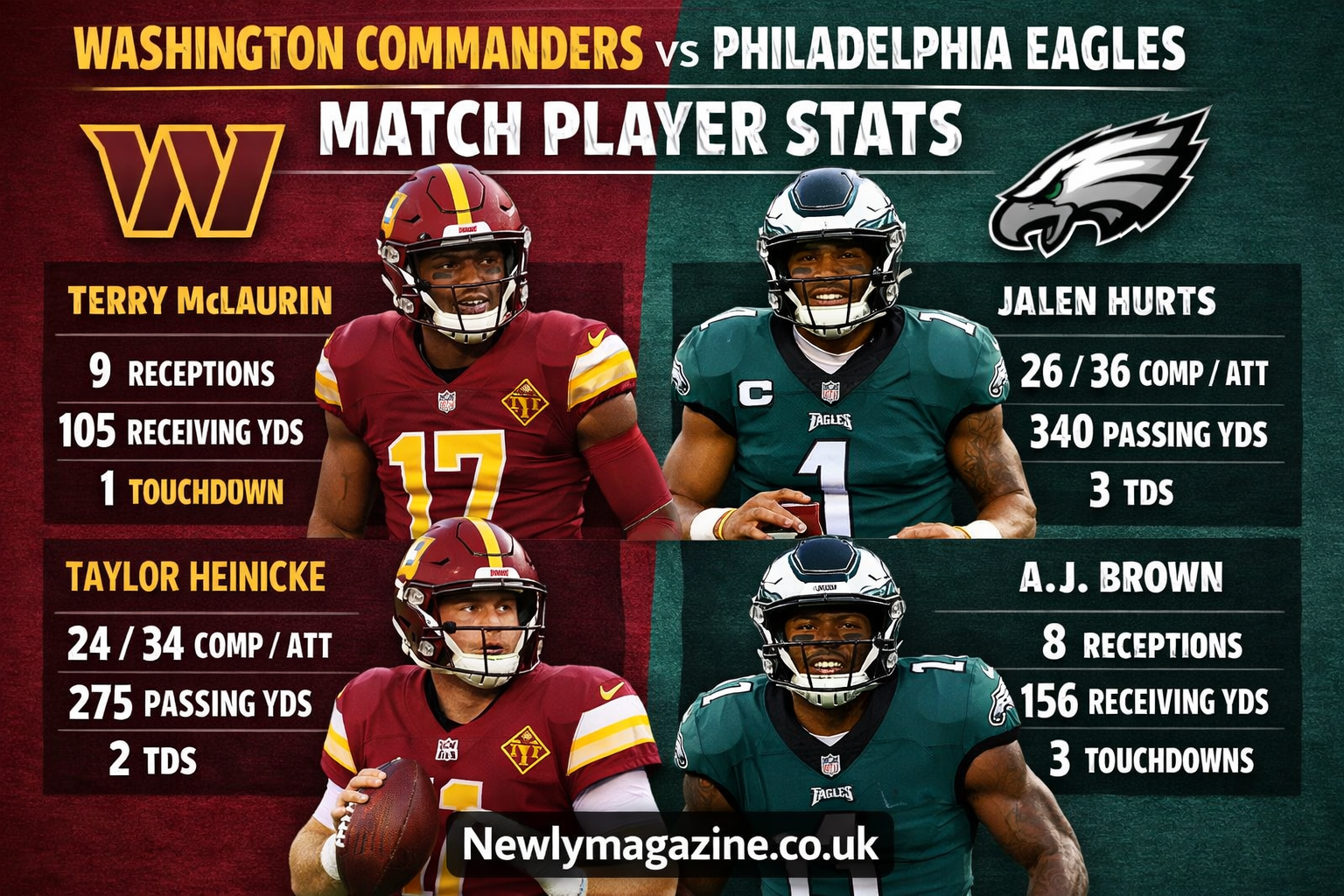
The matchup between the Washington Commanders and the Philadelphia Eagles has grown into one of the most compelling divisional rivalries in the National Football League. Whenever these two NFC East teams meet, fans expect intensity, physical gameplay, and standout individual performances. Beyond the final score, the real story often lies in the player statistics—quarterback efficiency, rushing dominance, receiving yardage, and defensive impact all shape the narrative of each encounter.
Understanding the “washington commanders vs philadelphia eagles match player stats” provides deep insight into how games are won or lost. These stats highlight not just star players but also emerging contributors and strategic execution. In this article, we take a detailed look at key player performances, statistical comparisons, and what these numbers reveal about both teams.
Quarterback Performance and Passing Stats
Quarterbacks are always at the center of attention in any NFL matchup, and games between the Commanders and Eagles are no exception. For Washington, players like Sam Howell have shown flashes of potential with strong arm talent and the ability to extend plays. In recent matchups, Howell’s passing yards often exceed expectations, sometimes crossing the 300-yard mark. However, turnovers—particularly interceptions—have been a critical factor affecting his overall efficiency rating.
On the Eagles’ side, Jalen Hurts stands out as one of the league’s most dynamic dual-threat quarterbacks. Hurts consistently delivers high completion percentages, often hovering around 65–70%, while also contributing significantly in the red zone. His touchdown-to-interception ratio is usually favorable, reflecting smart decision-making and strong offensive coordination.
When comparing stats, Hurts often leads in quarterback rating and rushing contributions, while Howell may edge ahead in total passing attempts due to Washington’s pass-heavy approach. This contrast highlights two different offensive philosophies—Philadelphia’s balanced attack versus Washington’s reliance on aerial plays.
Running Game Analysis
The rushing game plays a vital role in controlling the tempo, and both teams bring unique strengths to the ground attack. For the Commanders, Brian Robinson Jr. has emerged as a reliable power runner. His ability to gain tough yards between the tackles often results in steady first downs, even if explosive runs are less frequent. Robinson’s average yards per carry typically sits between 3.8 and 4.5, reflecting consistency rather than big-play explosiveness.
The Eagles benefit from a more versatile rushing offense. In addition to Hurts’ scrambling ability, players like D’Andre Swift contribute significantly with speed and agility. Swift’s yards per carry often exceed 5.0, making him a constant threat to break long runs. The Eagles’ offensive line, widely regarded as one of the best in the NFL, further amplifies their rushing success.
The Eagles usually outperform Washington in total rushing yards per game, largely due to their dual-threat quarterback and stronger offensive line play. However, Washington’s running game remains crucial in maintaining offensive balance and controlling possession time.
Wide Receivers and Receiving Stats
The receiving corps on both teams features talented playmakers capable of changing the game in a single moment. For the Commanders, Terry McLaurin consistently delivers top-tier performances. Known for his precise route-running and reliable hands, McLaurin frequently leads the team in receiving yards, often surpassing 80–100 yards per game against tough defenses.
Another key contributor is Jahan Dotson, whose speed and deep-threat capability add another dimension to Washington’s offense. Dotson’s touchdown receptions often come in crucial moments, highlighting his value in high-pressure situations.
On the Eagles’ side, A. J. Brown dominates with his physicality and ability to gain yards after the catch. Brown regularly posts 100+ yard games, making him one of the most dangerous receivers in the league. Complementing him is DeVonta Smith, whose agility and route precision make him a consistent target for Hurts.
The Eagles often hold an advantage in total receiving yards due to their balanced passing attack and multiple elite targets. However, Washington’s top receivers remain highly productive and capable of matching the Eagles’ output on any given day.
Defensive Standouts and Key Stats
Defense plays a decisive role in determining the outcome of Commanders vs Eagles games. For Washington, players like Jonathan Allen and Montez Sweat anchor the defensive line. These players consistently generate pressure on the quarterback, contributing to sacks and tackles for loss.
Washington’s defense often excels in pass rushing but can struggle against mobile quarterbacks like Hurts. Despite this challenge, their defensive stats frequently include multiple sacks and forced fumbles, showcasing their ability to disrupt offensive rhythm.
The Eagles’ defense is equally formidable, led by players such as Haason Reddick, who is known for his elite pass-rushing ability. Reddick’s sack totals often rank among the highest in the league, making him a constant threat to opposing quarterbacks.
The Eagles’ secondary, featuring players like Darius Slay, plays a crucial role in limiting big passing plays. Interceptions and pass deflections are common, helping Philadelphia maintain defensive dominance.
The Eagles often edge out Washington in total defensive efficiency, particularly in takeaways and third-down stops. However, Washington’s defensive line ensures they remain competitive in every matchup.
Special Teams Contributions
Special teams may not always grab headlines, but they significantly influence field position and scoring opportunities. For Washington, kickers and punters have delivered consistent performances, with field goal accuracy often exceeding 85%. Punt returns and kickoff coverage also play a role in maintaining competitive field position.
The Eagles’ special teams unit is equally reliable, often providing clutch field goals in close games. Their return game occasionally produces explosive plays, adding another layer to their overall performance.
When analyzing player stats, special teams contributions are often overlooked, but they can be the difference in tightly contested games between these two teams.
Head-to-Head Statistical Comparison
When comparing overall team stats in Washington Commanders vs Philadelphia Eagles matchups, several patterns emerge. The Eagles typically lead in total yards, particularly due to their efficient rushing attack and balanced offense. Their time of possession is often higher, reflecting their ability to sustain long drives.
Washington, on the other hand, tends to rely more heavily on passing yards. This results in higher total attempts and occasionally higher yardage totals, but also increases the risk of turnovers. The Commanders often excel in explosive plays, particularly through their wide receivers.
Turnovers remain a key statistical category. The Eagles generally maintain a positive turnover differential, which significantly contributes to their success. Washington’s ability to limit turnovers often determines whether they can compete effectively.
Impact of Coaching and Strategy on Player Stats
Coaching decisions play a crucial role in shaping player statistics. The Eagles’ offensive scheme emphasizes versatility, allowing players like Hurts, Swift, Brown, and Smith to maximize their strengths. This balanced approach often results in consistent statistical output across multiple categories.
Washington’s strategy, meanwhile, often focuses on aggressive passing and defensive pressure. While this can lead to impressive individual stats, it also introduces variability in performance. Coaching adjustments during games frequently impact player productivity, particularly in the second half.
Read More: Vanessa Trump: The Life, Family, and Public Journey of a Private Figure in a Famous Dynasty
Conclusion
The “washington commanders vs philadelphia eagles match player stats” tell a compelling story of contrasting styles and competitive intensity. The Eagles’ balanced offense and strong defensive play often give them a statistical edge, while the Commanders rely on explosive passing and defensive pressure to stay competitive.
Individual performances from players like Jalen Hurts, A.J. Brown, Terry McLaurin, and Jonathan Allen highlight the high level of talent on both sides. These stats not only reflect past performances but also provide insight into future matchups.
Analyzing player stats goes beyond numbers—it reveals strategies, strengths, weaknesses, and the evolving dynamics of one of the NFL’s most exciting rivalries.

Leave a Reply